
Washington, DC — "No one can say they didn't know."
In response to visual evidence of torture and mass killings of civilians trying to flee El Fasher, capital of Sudan's North Darfur region this week, urgent calls are increasing for an immediate ceasefire and accelerated diplomatic action to stop the fighting between the Sudanese Armed Forces (SAF) and the paramilitary Rapid Support Forces (RSF) and allied militias.
Nearly a hundred organizations signed an October 1 open letter issued by the Global Centre for the Responsibility to Protect, demanding safe passage for civilians under siege, in the face of "global paralysis".
Last month the Humanitarian Research Lab at the Yale University School of Public Health warned that the RSF's tightening encirclement of El Fasher has been strengthened with "at least 38 km of [earthen] berm encircling El-Fasher, and gaps in the berm are closing. Epidemiologist Nathaniel Raymond, Executive Director of the lab, speaking in obvious anguish, told U.S. National Public Radio this week that his team has been tracking the atrocities in real time. "Every day, my team and I watch El Fasher's destruction from space. No one can say they didn't know."
"International response to the war has been a study in diplomatic failure, defined by a proliferation of competing initiatives that actively undermine each other," Hafed Al-Ghwell, senior fellow at the Stimson Center in Washington DC, says in an analysis of external efforts to end Sudan's Deadly Conflict.
Negotiators block ceasefire
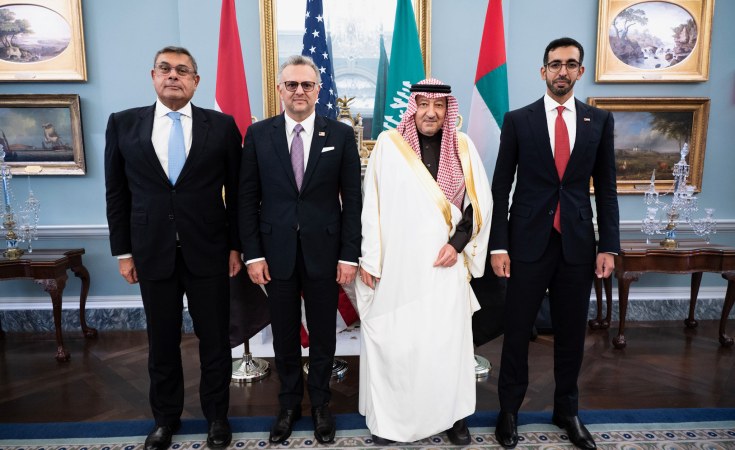
Talks last week in Washington, where representatives from Egypt, Saudi Arabia, the United Arab Emirates (UAE) and the United States – the 'Quad' – were unable to agree on a proposed three-month humanitarian pause in fighting, reportedly due to objections from the UAE. Alongside the official meetings, representatives from both the SAF and RAS held indirect discussions in their proxy war.
As the deliberations ended in stalemate, RSF forces were moving into El Fasher [also spelled Al-Fashir], dealing a serious setback to SAF allied forces and pushing the war closer towards widespread regional fighting.
Responding to the escalating disaster, U.S. Senior Advisor for Arab and African Affairs Massad Boulos, who hosted the Quad meeting, called on the RSF "to protect civilians and prevent further suffering" in an X post on Monday – joining similar and more strenuously stated condemnations of the calamity that already has spilled across borders. He followed with a post on Tuesday calling on the RSF to follow statements on civilian protection and humanitarian access with "concrete actions on the ground to alleviate the suffering of the Sudanese people."
The UAE has come under fire for mounting evidence of its large-scale support for the RSF, despite repeated denials by top Emirate officials. The Wall Street Journal on Sunday reported that the UAE has shipped "increasing supplies of weapons" into Sudan to shore up the RSF after a string of setbacks that culminated with the militia losing control of Sudan's capital, Khartoum, in March…that triggered some of the worst destruction in the two-year war." Quoting U.S. intelligence sources, the Journal said the supplied weaponry included "advanced Chinese-made drones along with small arms, heavy machine guns, vehicles, artillery, mortars and ammunition."
NOTE: Following publication of this article, the United Arab Emirates Ministry of Foreign Affairs requested that AllAfrica publish this statement to reflect "the official position in your coverage to ensure balance and accuracy."
"The war would be over if not for the UAE," Cameron Hudson from the Center for Strategic and International Studies, a former chief of staff to successive U.S. presidential special envoys for Sudan, told the Journal, adding that the RSF is able to keep fighting only because of "the overwhelming amount of military support that they're receiving from the UAE." The RSF is also reported to have UAE-supplied military hardware from the United Kingdom, France and Canada.
Among the latest massacres, the El Fasher Resistance Committees report that wounded and sick patients in the city's Saudi Hospital have been "collectively eliminated", along with civilians at the university and the Interior Ministry, according to a dispatch by Radio Dabanga.
"All attacks on health care MUST STOP immediately and unconditionally," World Health Organization head Dr. Tedros Adhanom Ghebreyesus said in a social media post. "WHO is appalled and deeply shocked by reports of the tragic killing of more than 460 patients and companions at Saudi Maternity Hospital in El Fasher, Sudan, following recent attacks and the abduction of health workers."
"UAE owns these atrocities, for it has armed the RSF even as it commits mass murder and mass rape" New York Times columnist Nicholas Kristof said in reply to the Tedros post.
Slaughters are increasing
As early as 2023, the Faculty Director of the Yale research lab, Dr. Kaveh Khoshnood and his colleagues urged that "international peacekeeping organizations set up a protective zone around El Fasher" to prevent the atrocities researchers saw as inevitable without such preventive action.
As evidence of the horrors get more attention from major media, condemnations of RSF actions grow. In the United States, influential lawmakers have taken notice. "The horrors in Darfur's El-Fasher were no accident - they were the RSF's plan all along," Senator James Risch (R-Idaho), who chairs the Senate Foreign Relations Committee, posted on X. "The RSF has waged terror and committed unspeakable atrocities, genocide among them, against the Sudanese people," he added, calling for the group to be officially designated as a foreign terrorist organization.
[NOTE: After this article was published, six senior Senators, including the Risch and ranking Committee Democrat Jeanne Shaheen, issued a strong condemnation of the RSF's "long-predicted, ethnically targeted assault" on El-Fasher's civilians and recommended a 'terrorist' designation for the paramilitary group and the "meaningful participation" by civilians in peace negotiations."]

House Foreign Affairs Committee Chairman Brian Mast and Ranking Member Gregory W. Meeks, in a statement today condemned "what amounts to the horrific conclusion of an 18-month siege in Al-Fashir, Sudan, where the genocidal campaign waged by the Rapid Support Forces" an cited "credible video and reports show summary extrajudicial mass executions, targeted ethnic cleansing against non-Arab communities—including the Fur and Zaghawa people—and the wholesale slaughter of civilians." Earlier, Meeks condemned as "unacceptable" UAE arms flows to the RSF and said his proposed legislation to cut off U.S. weapons sales to external actors funding the conflict in Sudan should be adopted. "The U.S. must do all we can to help end this devastating conflict."
The United Nations Security Council weighed in today with a press statement issued by Council President Russian Ambassador Vassily A. Nebenzia denoucing "reported atrocities being perpetrated by the RSF" and demanding "all parties to the conflict protect civilians and abide by their obligations under international law."
Diplomatic pressure – too little, too late
Kristof, whose August column on Sudan - No One Doubts That This Is Genocide - decries global inaction, says "Arab and African countries have done more to aggravate the suffering in Sudan than to ease it", blaming both the Trump and Biden administrations for refusing to hold the UAE accountable. He visited Darfur in September and published another piece toda y decrying global failure.
"The United States, whose influence once provided a forced, if flawed, coherence to regional diplomacy, now operates from a position of reduced leverage, channeling efforts through unwieldy constructs such as the Quad," says Hafed Al-Ghwell in his examination of the diplomatic record.
Kholood Khair who heads Confluence Advisory, a think tank founded in Khartoum, calls the recent American-brokered effort "poorly timed diplomacy that brings not enough leverage on the table to really get these two sides to commit to a ceasefire".
A report published by Ayin Network, an independent Sudanese media house, concludes that the U.S. goal is a short-term breakthrough "that could be presented as a success for the administration, without committing to deeper post-war reconstruction or political reform."
"American impotence" is how Hudson characterizes the administration's failure to lean on the UAE and other outsiders providing support to combatants. Without the kind of senior-level attention that other peacemaking efforts have seen, chances for success are nil. "There isn't a single cabinet level official or higher who has commented on Sudan" he posted.
RELATED:
'Horrified' by Sudan War, U.S. Senators Seek 'Terrorist' Designation for RSF and Civilian Inclusion in Peace Talks
Massacres Mount, Civilians Flee RSF's El-Fasher Takeover
Sudan's Deadly Conflict and the Shape of Wars to Come
Security Council Condemns 'Reported Atrocities Being Perpetrted by the RSF


